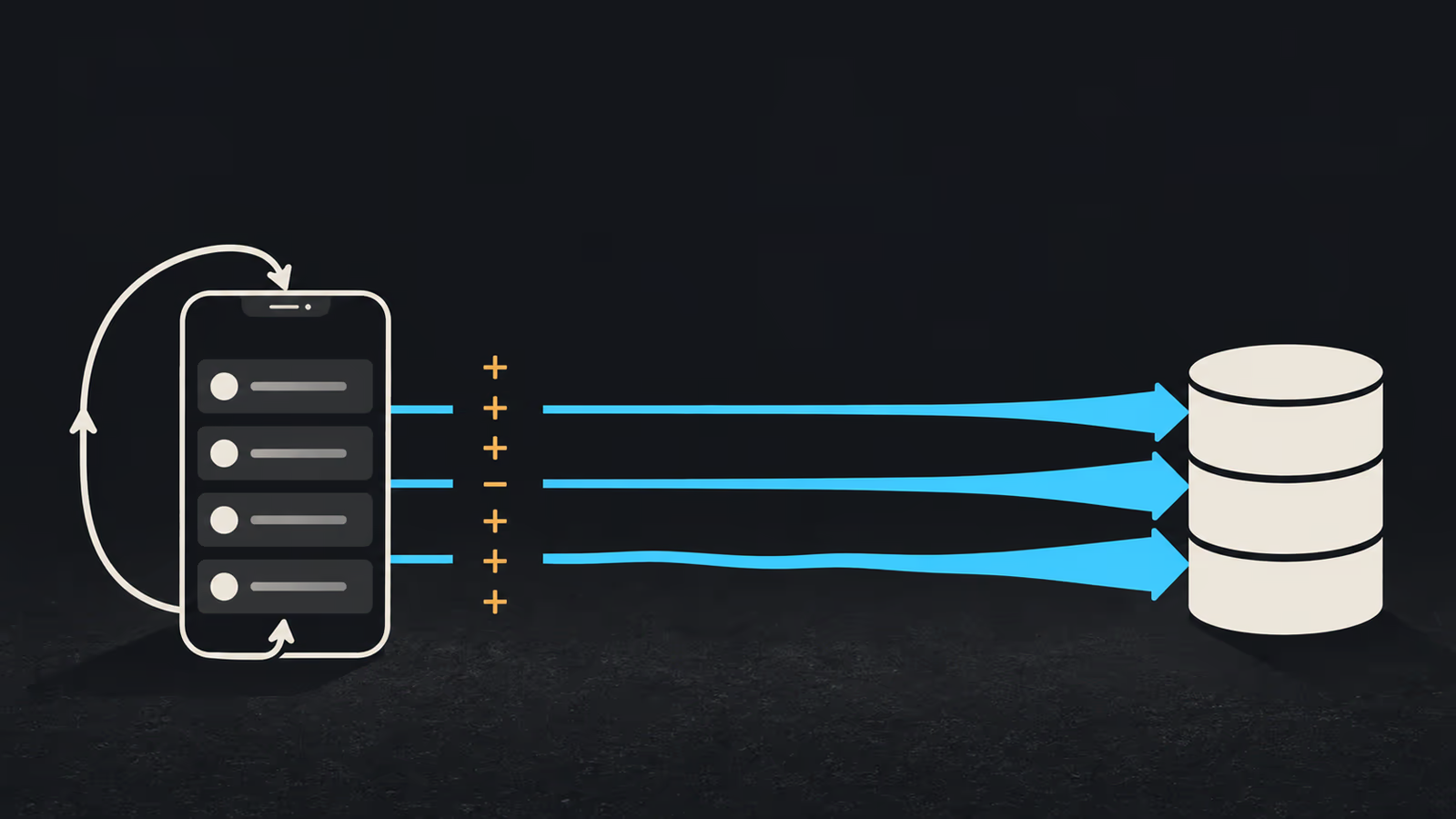

Stripe + Supabase: The Pattern for SaaS Subscriptions in 2026
Stripe delivers webhooks at-least-once, never exactly-once. That gap breaks naive insert handlers and untested RLS policies. Here is the pattern that keeps subscription state honest.
Notes from building real products — SaaS architecture, AI workflows, the trade-offs nobody warns you about.

Stripe delivers webhooks at-least-once, never exactly-once. That gap breaks naive insert handlers and untested RLS policies. Here is the pattern that keeps subscription state honest.

Prisma 7 dropped its Rust engine and cut its bundle 90%. Drizzle stayed tiny but has an open bug that silently disables Postgres RLS. Here's the honest trade-off for a Next.js SaaS.

tRPC, REST, and GraphQL solve different problems: internal type safety, partner interoperability, and multi-backend aggregation. Here's the split that holds up in production B2B SaaS.

Supabase, Neon, and Planetscale all sell Postgres in 2026, but the real choice is bundled auth versus standalone branching versus Vitess muscle memory in a new engine.

Next.js 15's App Router still trips SaaS teams on three calls: Server Actions vs Route Handlers, what Next.js 16 changed about caching, and dashboard layouts that don't block on a slow query.

Stripe subscriptions have eight states, not two, and the costliest bug isn't a missing webhook. It's a status column that quietly stops matching what actually gates access.

Stripe's hosted portal saves you a UI, not the webhook work underneath it. How to wire it to Auth.js in Next.js, and the cookie bug that silently logs users out after a redirect.

Resend has no built-in sequencing engine, so a real day-0-to-day-30 onboarding sequence lives in your app, not a dashboard. What that means for scheduling, branching, and cancellation.

Serverless Postgres burns through connections fast. PgBouncer transaction mode, the Supabase pooler, and Prisma pgbouncer=true don't work the way five-year-old advice claims they do.

RPO and RTO are checkbox metrics until something breaks. Here is the real math on Postgres PITR, restoring one tenant from a shared backup, and a DR testing cadence that actually happens.

Most SaaS teams that reach for microservices actually need honest module boundaries instead. Here is how to find bounded contexts, extract them safely, and know when a monorepo tool earns its keep.

Most feedback widgets get one submission a week because they fire at the wrong moment and the input goes nowhere. Here is the trigger timing, routing, and capture pattern that works.

Tenant provisioning creates a customer's environment at signup or deal close. Here is the state machine, the race conditions to prevent, and when to add a sales-assisted trigger.

Enterprise SSO blocks more B2B SaaS deals than slow software. Here is what SAML, SCIM, and JIT provisioning actually require — and how to sequence them.

What actually moves the needle on a SaaS pricing page: tier count, annual defaults, anchor positioning, and why most A/B test results are wrong before data collection starts.

Free trial design that converts: why credit card at signup outperforms opt-in by 3x, the 14-day trial data, and how to wire the Stripe trial_will_end webhook.

Direct-to-S3 upload with presigned URLs, three-bucket virus scanning, tenant folder isolation, and signed serving — the production file upload architecture for B2B SaaS.

Supabase Realtime, Liveblocks, and PartyKit solve different real-time problems. Concrete pricing, limits, and failure modes for each — so you pick the right one before production.

Postgres FTS works until it doesn't. Here's the exact threshold where Typesense wins on relevance, what Algolia costs at scale, and how to isolate tenant search data safely.

A real, line-by-line budget for a SaaS MVP: build labor, recurring infrastructure, payments, domain and email, design, and the hidden costs nobody quotes you. With concrete ranges and how solo versus agency changes the math.

How to build web templates worth selling: design judgment, clean front-end engineering, marketplace economics, and getting the work cited by AI search.

How to build a SaaS support inbox with Resend's inbound webhooks: threading, multi-tenant routing, attachment handling, and when to stop building and buy Plain or Front.

A practical decision guide for non-technical founders: when a solo developer beats an agency, when an agency wins, and when an in-house team is the only sane choice for building your SaaS.

Your buyers ask ChatGPT before they open Google. Make your SaaS legible to AI assistants with llms.txt, the right robots rules, and content built to be quoted.

How to architect a SaaS notification system across in-app, email, and push: fan-out routing, preference management, digest grouping, and when to buy Knock, Courier, or Novu.

What web apps and SaaS actually cost, how dev pricing breaks down, and the regional realities of building from Bosnia, Croatia, and Serbia.

Token bucket, sliding window, or fixed window — the algorithm is rarely the main problem. Bucket key strategy, middleware order, and fallback behavior are where SaaS incidents live.

A practical guide to product analytics for SaaS: how to define activation, instrument the events that matter, and read retention curves so you fix the right thing instead of vanity numbers.

A buyer-decision hub for non-technical founders: how to choose a development partner, what outsourcing costs, how to vet an agency, and when a managed platform fits.

Audit logs close B2B enterprise deals, not just compliance checkboxes. Schema, query patterns, retention requirements, and the 10 events every enterprise security reviewer checks first.

How SaaS UX drives growth: design a website that converts, an onboarding flow that activates users, and the systems that turn signups into retained, paying customers.

What an internal SaaS admin panel actually needs in year one: customer impersonation, subscription state inspector, billing actions, and audit logs.

A practical retention playbook for SaaS founders: cut voluntary and involuntary churn with onboarding fixes, failed-payment recovery, save offers, and the few metrics that actually predict cancellations.

The three DNS records that keep your SaaS password resets out of spam. Full setup for SPF, DKIM, DMARC, subdomain strategy, provider selection, and inbox reputation.

The plumbing every production SaaS needs: background jobs, reliable webhooks, transactional email deliverability, notifications, a support inbox, and an internal admin dashboard.

Three layers every production SaaS webhook handler needs: signature verification, event-ID idempotency, and a dead-letter queue with a working replay path.

A practical guide to SaaS observability: structured logs, the metrics that matter, traces, and alerts that page you only when something is genuinely broken.

A practical guide for B2B founders to get SOC 2 audit-ready, handle EU data under GDPR, prove who-did-what with audit logs, and protect your API with rate limiting.

Inngest, Trigger.dev, or Vercel Cron plus a queue — here is how each option breaks down at 10k, 100k, and 1M jobs/month for production SaaS.

A practical Redis caching playbook for SaaS: cache-aside, write-through, per-tenant key namespacing, TTL choices, and the invalidation traps that cause stale-data bugs.

When does B2B SaaS actually need multiple regions? The latency thresholds, regulatory triggers, Supabase read replicas, and the cost ceiling that kills multi-region deployment early.

How to build revenue infrastructure for SaaS with Stripe: subscription billing, usage-based metering, and a pricing page that actually converts paying customers.

Production-grade usage-based billing with Stripe's Billing Meters API: how meters work, idempotency gotchas, late-arriving events, and when Lago is the smarter choice.

How to isolate tenant data, pick a tenancy model, enforce access at the database layer, handle authentication, and decide when multi-region is worth it.

GDPR compliance for B2B SaaS isn't a policy problem — it's an architecture one. Data inventory, erasure flows, SAR automation, and sub-processor disclosure, built in code.

How to store, rotate, and scope API keys and secrets in a SaaS app: server-side storage, environment variables, key rotation, least-privilege scoping, and the leaks to avoid.

SOC 2 Type I proves your controls are correctly designed — not that they run reliably over time. Here's the 90-day checklist for SaaS startups doing it right the first time.

Free trial vs freemium is a packaging decision, not a pricing detail. This guide breaks down when each model wins, how they affect activation and conversion, and how to wire them into Stripe without painting yourself into a corner.

How an AI-augmented solo developer ships production software at agency speed: the workflow, the quality controls, and the exact line between where AI helps and where human judgment stays.

SaaS auth in 2026: why magic links fail in corporate email environments, when enterprise SSO becomes non-negotiable, and what an Auth.js stack actually looks like in production.

Most B2B SaaS products lose two-thirds of signups before activation. Here are the onboarding patterns — sample data seeding, role-split flows, team-invite hooks — that actually move the number.

How to build a SaaS MVP that ships in weeks, not quarters: scoping, the realistic timeline, the stack, and the path from idea to first paying customers.

The three multi-tenant database patterns compared: shared schema with RLS, schema-per-tenant, and database-per-tenant — with the ops math most architecture decisions skip.

A practical guide to recovering failed SaaS subscription payments: how dunning works, retry timing, recovery emails, card-updater tools, and how to cut involuntary churn without annoying paying customers.

A head-to-head on enforcing multi-tenant isolation in the data layer: Firestore security rules vs Postgres RLS, grounded in the Callidus production build.

What actually happens between a user clicking sign up and their tenant being ready to use — the provisioning steps, idempotency rules, and onboarding flow that keep new SaaS customers from churning on day one.

My best-selling FlutterFlow template has sold 18 copies. My most-downloaded one is free with 1,700 downloads. Here's the honest account of what the FlutterFlow Marketplace templates economy actually rewards — cover images, categories, review traps, and support overhead.

Three to four tiers, the right billing model, a clear anchor, and FAQ that neutralises deal-killers before they land. The b2b saas pricing page patterns that actually shift conversion rates.

How to design RBAC for a multi-tenant SaaS so roles, tenant isolation, and the data layer all agree — with patterns from the Callidus and BookBed production builds.

Postgres Row-Level Security enforces tenant isolation at the database layer. Tenant model, policy patterns, the recursive subquery trap, and the indexes that keep multi-tenant Supabase fast in production.

Space tourism is a category with three real buyers and ten waiting lists. Horizon is the seventh template in the marketplace — a single-page voyage booking site with six orbital destinations, a horizon-line video hero, and a scroll-driven background tint that walks from black sky to lunar dawn.

Musician sites are a Spotify link and a tour dates list. Echo is the sixth template in the marketplace — a single-page album landing with an ink-in-water hero, a 3D arc track slider, a cursor-driven Spotlight, and a per-track scrubbable waveform.

Most solar installer sites are stock panels and a quote form. Helia is the fifth in a five-template marketplace — a Framer Motion + Boomerang-video build that earns attention without selling sustainability theater.

Furniture e-commerce sites usually pick a side: IKEA listing dump or art gallery without product. Norraform is the fourth template in a five-site marketplace — a quiet Scandinavian e-comm build that picked neither.

Fintech sites scream "compliance" in beige rectangles. Arclight is the third template in a five-site marketplace — a dark fintech landing with liquid-ripple video, animated trust marquee, and real leadership photos in place of stripey placeholders.

Telehealth sites read like waiting-room paperwork. Lumenly is the second template in a five-site marketplace — a light-theme telehealth landing built around trust signals, calm motion, and a single accent word in the headline.

Most car dealer websites look like 2008 called and wanted its inventory grid back. Veloce is the first of five templates I shipped this week — a GSAP-driven dark car dealer build with cinematic video plates, sticky scroll heroes, and three bugs I caught in QA.

A production-grade Stripe subscription billing setup for SaaS: webhook idempotency, proration edge cases, trial logic, dunning, and annual invoicing patterns from two live products.

A 12-question framework you can run on a single discovery call to separate competent SaaS development agencies from sales-front shops, plus three red flags that justify walking away at any price.

A week-by-week roadmap for building a SaaS MVP in 12 weeks: spec lock, auth and tenant model, core build, billing, hardening, and a closed beta, with the real failure points.

How a solo developer uses AI for code review without losing control of quality: what AI catches well, what it misses, and the layered quality gates that keep production software correct when there is no second pair of human eyes.

A practical decision framework for choosing between no-code and custom code for your first SaaS MVP, with real examples of when each one wins and when it costs you a rebuild.

Real 2026 cost ranges for outsourcing SaaS development — agency vs senior freelancer vs offshore — with a breakdown of what drives the number, the hidden costs nobody quotes, and how to budget for a 6-month MVP.

When Webflow + Zapier is the right SaaS MVP stack for the first 100 customers, the five concrete signs you have outgrown it, and a six-step migration plan to a custom backend when the time comes.

A concrete framework for deciding which SaaS MVP features ship first and which wait: name the core loop, score every feature against it, and cut everything that does not earn its place.

Everything you need to build and ship a SaaS MVP in 2025 — from scoping and tech stack selection to launch and first paying customers. A practical guide from someone who has done it.

A practical breakdown of how AI-augmented development works in a real full-stack practice — what it automates, where human judgment is irreplaceable, and why faster delivery does not mean lower-quality code.

Practical tips for building a website that ranks, loads fast, and converts visitors — from hosting selection through technical SEO to ongoing performance monitoring.

A practical framework for planning, building, and launching a SaaS MVP — covering market validation, tech stack selection, team structure, KPIs, and customer acquisition.

A practical breakdown of the SaaS product lifecycle — from early planning and architecture through launch, iteration, and long-term scaling — with real patterns that work.

A practical guide to outsourcing SaaS development — when it makes sense, how to vet partners, structure contracts, manage remote teams, and avoid the most common mistakes.

A practical guide to SaaS website design — hero section structure, navigation, pricing page patterns, social proof, and conversion optimisation backed by real-world examples.

Honest breakdown of website development costs in the Balkans — what a basic site, e-commerce build, and custom web app actually costs, and what drives prices up or down.

A practical overview of the AWS SaaS Factory program — what it offers, how it supports the SaaS product lifecycle, and whether it makes sense for your stage of development.

A practical look at AI SaaS solutions in 2025 — how they automate business processes, what to evaluate before buying, and how to avoid common implementation mistakes.