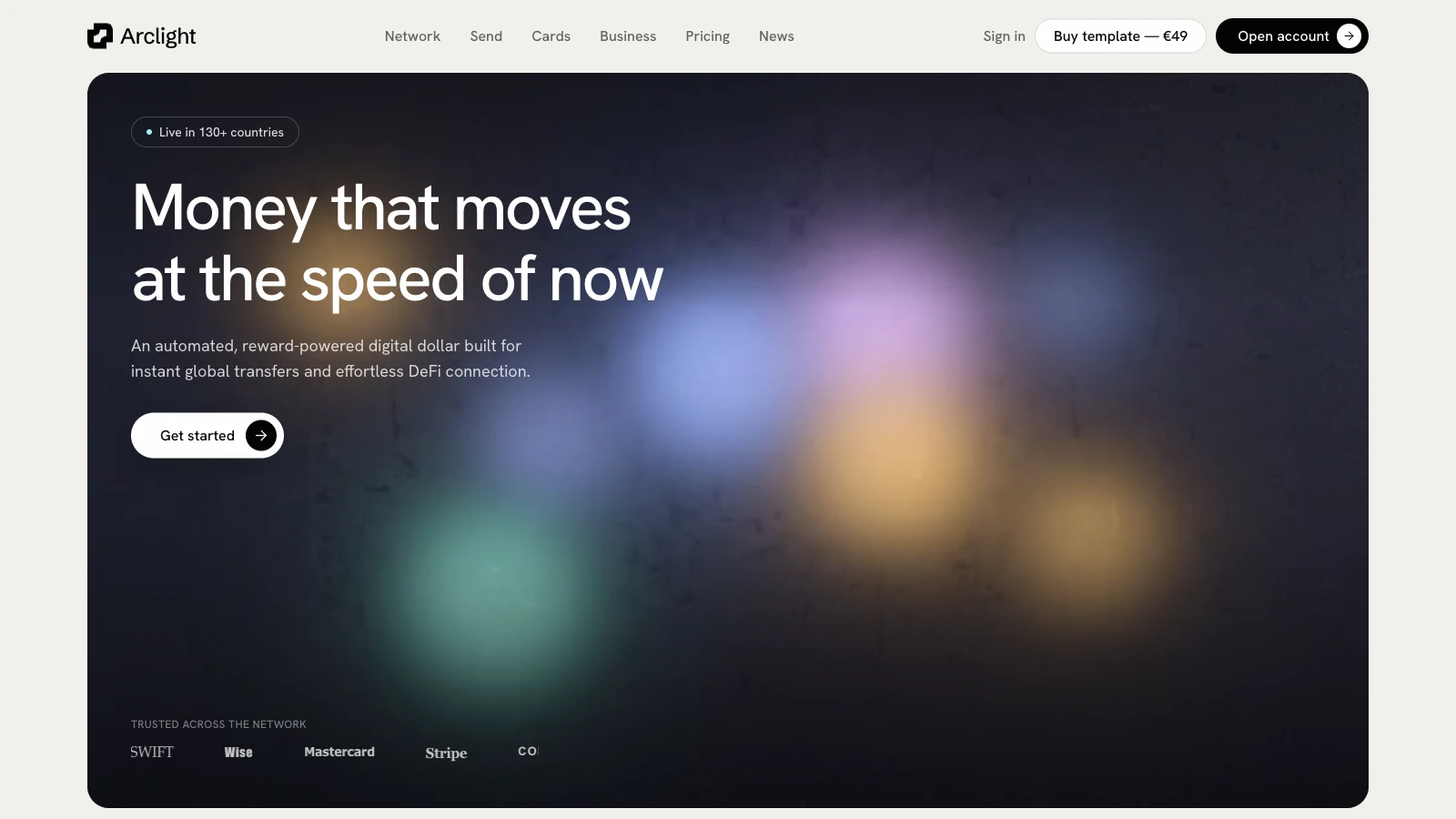
If you're looking for a fintech website template, you probably need a landing page that sells speed and trust without looking like a bank brochure, plus a few secondary pages (pricing, security, help) that you can edit without a build pipeline. Arclight is one of my web templates aimed at that brief. Open the live demo and keep the page source open while you read. I checked everything below against the deployed files on 2026-09-30, and where the code disagrees with what an earlier version of this post said, the code wins.
One label up front: Arclight is a demo. Every number, partner name, investor, licence, audit badge, exchange rate and FAQ answer in it is placeholder copy written to make the layout look complete. "Live in 130+ countries", "SOC 2 Type II", "Licensed" and the 5.1% reward rate describe no real company or product. The template has no backend, no identity check and no payment processing, so it implements no financial compliance at all.
What should a fintech website template include?
A fintech website template should explain what the product does, show how money moves, answer trust questions and give one clear next step. Arclight covers that with a homepage of eight sections and 14 static pages.
The homepage, in order, is a hero, an intro section, a phone showcase, a three-step "How it works" (send, convert, settle), a rewards calculator, a FAQ with a rotating rate card, a "Backed by" grid and a security band. The other pages are Send, Business, Cards, Network, News, About, Pricing, Security, Help, Careers, Auth, Legal and a Style Guide. Each one is its own HTML file that loads the same shared scripts and then one page script, so you can edit a page without touching the rest.
| Section | What it does | Placeholder content |
|---|---|---|
| Hero | Video background, one "Get started" button, logo marquee | "130+ countries" pill, seven partner names |
| Rewards calculator | Balance slider from $1,000 to $250,000, 1, 3 or 5 years | The 5.1% APY |
| FAQ and rate card | Five questions, six rotating currency pairs | Transfer limits, rates, "40+ currencies" |
| Backed by | Eight investor names | All of them |
| Security band | Four proof points | Encryption, reserves, SOC 2, licences |
Why does the hero have only one button?
The hero has a single "Get started" button, and the earlier post was right about that part. A second "Schedule a demo" button would ask the visitor to choose a path before the page has said anything. That's my design opinion, not a measured result, and I haven't run an A/B test on it. One more detail from the source: the button is a plain <button> with no link, so you have to wire it to your real sign-up before launch.
What does the trust marquee actually do?
The logo strip in the hero scrolls seven names (Stripe, Coinbase, Visa, Plaid, SWIFT, Wise, Mastercard) at a 22-second linear loop and pauses on hover. The earlier post listed four names and a 38-second loop, so both details were wrong. The names are set in system fonts, not real logos, and the strip is hidden from screen readers with aria-hidden. Naming real payment brands in a placeholder strip implies a partnership that doesn't exist. Replace it with your own partners or remove it.
How is the Arclight fintech template built, and what does it cost the browser?
Arclight is static HTML that loads Tailwind from its Play CDN, React 18.3.1 development builds and @babel/standalone 7.29.0, so it edits quickly but needs a build step before real traffic. Each page compiles a handful of JSX files in the visitor's browser.
The homepage loads icons.jsx, media.jsx, tweaks-panel.jsx, sections.jsx, chrome.jsx, showcase.jsx and app.jsx. The earlier post called the front end "React 18 UMD shell, Babel in the browser, Tailwind via CDN", and that still holds. What it got wrong is the page structure: the pages aren't one shell mounting different page components. Each HTML file loads the shared scripts plus its own file (for example pricing.jsx or security.jsx).
Two things deserve a flag. The Tailwind docs say the Play CDN is designed for development purposes only and isn't intended for production, and the React files are development builds. My Tailwind CSS glossary entry and the Tailwind v4 production migration post cover the compile step you'd add.
How heavy are the videos?
The hero clip hero-glass.mp4 is 651,040 bytes, and the fallback clip liquid-ripple.mp4 is 2,764,817 bytes, measured with HEAD requests on 2026-09-30. For context, the HTTP Archive Web Almanac 2024 page weight chapter reports the median page weight in October 2024 at 2,652 KB on desktop and 2,311 KB on mobile, and video responses at the 90th percentile at 2,835 KB on desktop and 3,432 KB on mobile. The primary hero clip is small next to those numbers. The fallback is the heavy one, and it only loads if frame capture fails.
Where did the old claims about file sizes and tooling go?
The earlier version described a 1280-wide H.264 transcode at CRF 26 and a Veo watermark removal with an ffmpeg delogo pass. I can't verify an encoder setting or a watermark step from the deployed files. I can verify that the hero clip is 1280 by 720, 24 frames per second and 8 seconds long, read with ffprobe on the downloaded file. I dropped the rest. The same goes for the "Gemini Veo" origin: the source doesn't say where the clip came from.
How does the boomerang hero work, and what does it cost in memory?
The hero plays the clip once while copying frames to a canvas, then steps through them forward and backward at about 30 frames per second, so any clip loops without a visible jump.
In BoomerangVideoBg, each captured frame is drawn at up to 960 pixels wide. It uses requestVideoFrameCallback when the browser has it, which MDN lists as Baseline 2024 and describes as running a callback when a new video frame is sent to the compositor. Without it, an interval that fires 60 times a second does the capture. When the video ends, the canvas takes over. If fewer than two frames were captured, or nothing usable loads within nine seconds, the component falls back to a plain muted loop of the second clip.
Is the frame buffer a problem?
It might be, and this is an estimate, not a measurement. Unlike the Helia template, which I wrote about in the solar template post and which stops at 140 frames, Arclight's capture has no frame cap. A clip of 8 seconds at 24 frames per second is about 192 frames. At 960 by 540 pixels, each frame is about 2.1 MB of RGBA pixels, so the buffer is on the order of 400 MB before any browser compression. I haven't profiled it on a phone. If you keep this technique, cap the frame count, test on a mid-range device, and read why Mobile Safari reloads video-heavy pages for how that kind of pressure shows up.
Does the hero respect reduced motion?
Only partly, and the template's own Style Guide overstates it. The Style Guide says all motion respects prefers-reduced-motion. The stylesheet does disable the reveal and load animations, and the count-up and rotating rate card check the preference in code. But media.jsx, where the boomerang lives, has no such check, so the hero keeps moving. MDN explains the media feature as a way to detect a device setting that minimizes non-essential motion, and WCAG 2.2 criterion 2.3.3 covers motion triggered by interaction. Add the check to the hero before you ship to real users.
Which parts of a fintech demo are placeholder, and what must you verify before launch?
Almost everything a visitor would rely on is placeholder, including rates, limits, licences, audits, investors and reserve claims, so replace each with a fact you can prove or remove it.
- Exchange rates. The Send page and the rate card use fixed values (USD to EUR 0.92, GBP 0.79, NGN 1,480, PHP 58.2, INR 83.4, BRL 5.07). The word "Live" next to them is a label, not a feed.
- Rewards. The calculator uses a constant 5.1% APY and compounds it. It says "Illustrative projection... not financial advice", which is the right kind of label, but the number is invented.
- Security and compliance. The Security page lists SOC 2 Type II, PCI DSS Level 1, ISO 27001, GDPR and CCPA badges, money-transmission licences in "every region", AES-256 and TLS 1.3, and balances held one-to-one in cash and treasuries. None of it is implemented here, because there's no service behind the pages.
- Terms and Privacy. The Legal page is sample text. It is not legal advice and it's not a document to copy.
- Sign-in. The Auth forms call
preventDefaultand do nothing else.
Regulation is where fintech differs from other template categories. In the United States, FinCEN states that no activity threshold applies to the definition of a money transmitter, so a person who transfers funds as a business is a money services business regardless of volume. That page is federal registration guidance, not a full picture, because state licensing and other countries' rules differ. A template can't answer those questions, and a "Licensed" badge on a page doesn't make anyone licensed. If you build a real product, take the requirements to a qualified lawyer.
To verify my reading yourself:
- Open the Network tab and compare
hero-glass.mp4andliquid-ripple.mp4with the sizes above. - Turn on reduced motion in your operating system, reload, and watch whether the hero keeps moving.
- Open the Send page, change the corridor, and compare the result with the fixed rates in
send.jsx. - Read the Security page and list every claim you'd need evidence for.
- Check which HTML files exist by opening the footer links, then compare with the 14 pages above.
For how I package and sell these templates, read Building Web Templates: Design, Engineering, and Selling. For a sibling built for a different audience, see Lumenly, the telehealth template.
Your next step: open the Security page, pick the one claim you'd have to prove first, and decide whether you can.